
Birth to Five: Building the Foundation for Reading
You don’t need special training or fancy tools to raise a reader. Every parent has what it takes.
By Dr. Ric, Head of School at The Yutzy School

You don’t need special training or fancy tools to raise a reader. Every parent has what it takes. From lullabies to Bible stories to playful chatter in the grocery store, the path to reading begins with you. And when it does, your child’s first day of school becomes the next step in a journey already well underway.
The years from birth to age five are the most powerful time for building the foundation of reading. During this window, a child’s brain is growing rapidly, soaking up sounds, words, rhythms, and stories like a sponge. The good news? You don’t need a teaching degree to help your child become a strong future reader—you just need a little intention and a lot of love.
Talk Constantly
Narrate your day: “Now we’re washing the apples. Look at the bubbles!” The more words your child hears, the more their vocabulary grows. Use real words and rich language—your toddler doesn’t need “baby talk.”
Research indicates that engaging in back-and-forth conversations with children significantly enhances their brain development and language skills (Romeo et al., 2018).
Read Aloud Every Day
This is the single most powerful thing you can do. Choose books with rhythm, rhyme, and repetition. Let your child turn the pages, finish predictable phrases, or name the pictures. It’s about connection, not perfection.
Reading aloud to children has been shown to improve vocabulary, comprehension, and attention skills (Duursma, Augustyn, & Zuckerman, 2008).
Sing Songs and Recite Rhymes
Singing slows language down and makes the sounds in words easier to hear. Nursery rhymes, fingerplays, and silly songs help your child develop 'phonological awareness'—a critical skill for sounding out words later on.
Knowledge of nursery rhymes has been linked to enhanced phonological awareness and early reading skills (Bryant et al., 1990).
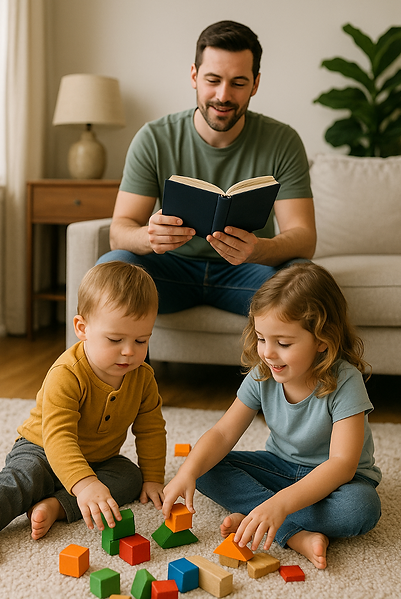
Let Them See You Reading
Whether it’s a novel, a recipe, or the grocery list—when kids see you reading, they understand that reading is valuable. Let them “read” too, even if it’s just flipping through a magazine or holding a book upside down.
Children who observe their parents reading are more likely to develop positive attitudes toward reading themselves (Bus, van IJzendoorn, & Pellegrini, 1995).
Talk About Letters and Sounds
Point out letters on signs, cereal boxes, or shirts. Say things like, “Look! That’s an M—M for Mommy!” Don’t drill—just playfully draw their attention to letters and sounds in everyday life.
Early knowledge of letter names and sounds is a strong predictor of later reading success (Piasta, Petscher, & Justice, 2012).
Build Fine Motor Skills
Believe it or not, scribbling with crayons, playing with playdough, or stringing beads is prepping your child to hold a pencil and form letters. These small hand muscles matter!
Fine motor skill development is closely linked to handwriting and academic achievement in early childhood (Cameron et al., 2012).
Keep It Fun and Pressure-Free
Every child learns at their own pace. Focus on joyful experiences and quality time. A child who loves books and feels confident will learn to read—often faster and with less frustration.
Positive early literacy experiences are associated with increased motivation and interest in reading (Sénéchal & LeFevre, 2002).
Let Them Explore Books on Their Own
Before a child can read a single word, they can still develop a love for books. Let your child hold books, turn the pages, and explore them freely. Board books and fabric books are especially good for babies and toddlers.
Independent exploration of books helps children develop print awareness and early literacy skills (Justice & Ezell, 2001).
Celebrate Pretend Reading
If you catch your child holding a book and 'reading' out loud—even if it’s just babble or making up a story—that’s cause for celebration! Pretend reading shows that your child understands that books tell stories.
Engaging in pretend reading activities supports narrative skills and comprehension (Sulzby, 1985).
Enlist Help
Invite grandparents, siblings, and friends to read to your child. Each voice, each story, and each loving interaction adds depth to your child’s experience with books.
Family involvement in literacy activities has a positive impact on children's reading development and attitudes toward reading (Bus et al., 1995).
%20sitting%20on%20he.png)
Read the Bible Together
Even before your child can read, opening the Bible together is a powerful and sacred habit. The rich language, repetition, and rhythm of Scripture nurture early literacy skills while also planting seeds of faith. Whether you use a storybook Bible or read directly from Scripture, let your child hold the Bible, turn the pages, and listen as you read aloud. You can also invite your child to repeat short phrases or verses after you. This kind of mimic reading helps children learn to pronounce new sounds, tackle big words, and build their listening and comprehension skills—one small phrase at a time.
These moments do more than build vocabulary—they also build spiritual foundations. As Christian educator Joanne Graham (2015) beautifully states, 'The rhythms of Scripture shape not only the spirit, but the ear and tongue of the child.' When we read God’s Word with our children, we’re forming both readers and disciples.
Shared reading of Scripture supports early literacy development, especially when using age-appropriate Bible storybooks (Barclay, 2011).
You Can Do This
My wife Christy and I have raised seven children, each with their own timeline when it came to reading. We learned that consistency, not comparison, was the key. The daily routines of reading, singing, and playing with words made a lasting impact—and helped turn our home into a place where books were treasured.
You are your child’s first and most important teacher. Every story you share, every silly rhyme you repeat, and every question you answer builds a bridge to literacy. So snuggle up with a book tonight. You’re not just reading—you’re shaping your child’s future.
Start today. Choose one of these simple habits, and build from there. Your child’s reading journey begins with you.
References
Barclay, M. A. (2011). Children, Scripture, and the use of Bible storybooks. *Christian Education Journal, 8*(2), 266–282. https://doi.org/10.1177/073989131100800208
Bryant, P. E., MacLean, M., Bradley, L. L., & Crossland, J. (1990). Rhyme and alliteration, phoneme detection, and learning to read. *Developmental Psychology*, 26(3), 429–438.
Bus, A. G., van IJzendoorn, M. H., & Pellegrini, A. D. (1995). Joint book reading makes for success in learning to read: A meta-analysis. *Review of Educational Research*, 65(1), 1–21.
Cameron, C. E., Brock, L. L., Murrah, W. M., Bell, L. H., Worzalla, S. L., Grissmer, D., & Morrison, F. J. (2012). Fine motor skills and executive function both contribute to kindergarten achievement. *Child Development*, 83(4), 1229–1244.
Duursma, E., Augustyn, M., & Zuckerman, B. (2008). Reading aloud to children: The evidence. *Archives of Disease in Childhood*, 93(7), 554–557.
Justice, L. M., & Ezell, H. K. (2001). Word and print awareness in 4-year-old children. *Child Language Teaching and Therapy*, 17(3), 207–225.
Piasta, S. B., Petscher, Y., & Justice, L. M. (2012). How many letters should preschoolers learn? *Early Childhood Research Quarterly*, 27(1), 102–114.
Romeo, R. R., Leonard, J. A., Robinson, S. T., West, M. R., Mackey, A. P., Rowe, M. L., & Gabrieli, J. D. E. (2018). Children's conversational exposure and language-related brain function. *Psychological Science*, 29(5), 700–710.
Sénéchal, M., & LeFevre, J. A. (2002). Parental involvement in the development of children's reading skill. *Child Development*, 73(2), 445–460.
Sulzby, E. (1985). Kindergarteners as writers and readers. In M. Farr (Ed.), *Children’s early writing development* (pp. 127–199). Ablex Publishing.